
Training for the rare moments
When a cloud crosses the solar park or an engine trips, your operators have seconds to act. Engineer on Shift builds a simulator of your own grid, so they can practise those moments without risk.
You cannot practise on a running plant
The events that decide whether the lights stay on happen once a year, or once a decade.
A generator drops off the bus
Spinning reserve disappears in a second. Operators must bring standby units online fast.
Renewables dip faster than engines start
A cloud over the solar park or a wind drop pulls frequency down, and load shedding follows.
Black start after a blackout
Operators restore a dead grid step by step, and nobody can rehearse that on an engine supplying the island.
See the approach in two minutes
Aruba’s island grid as a worked example.
Try the island grid simulator
A 60 Hz island grid inspired by Aruba, with six 17 MW units, solar, wind and a full generator panel for G6.
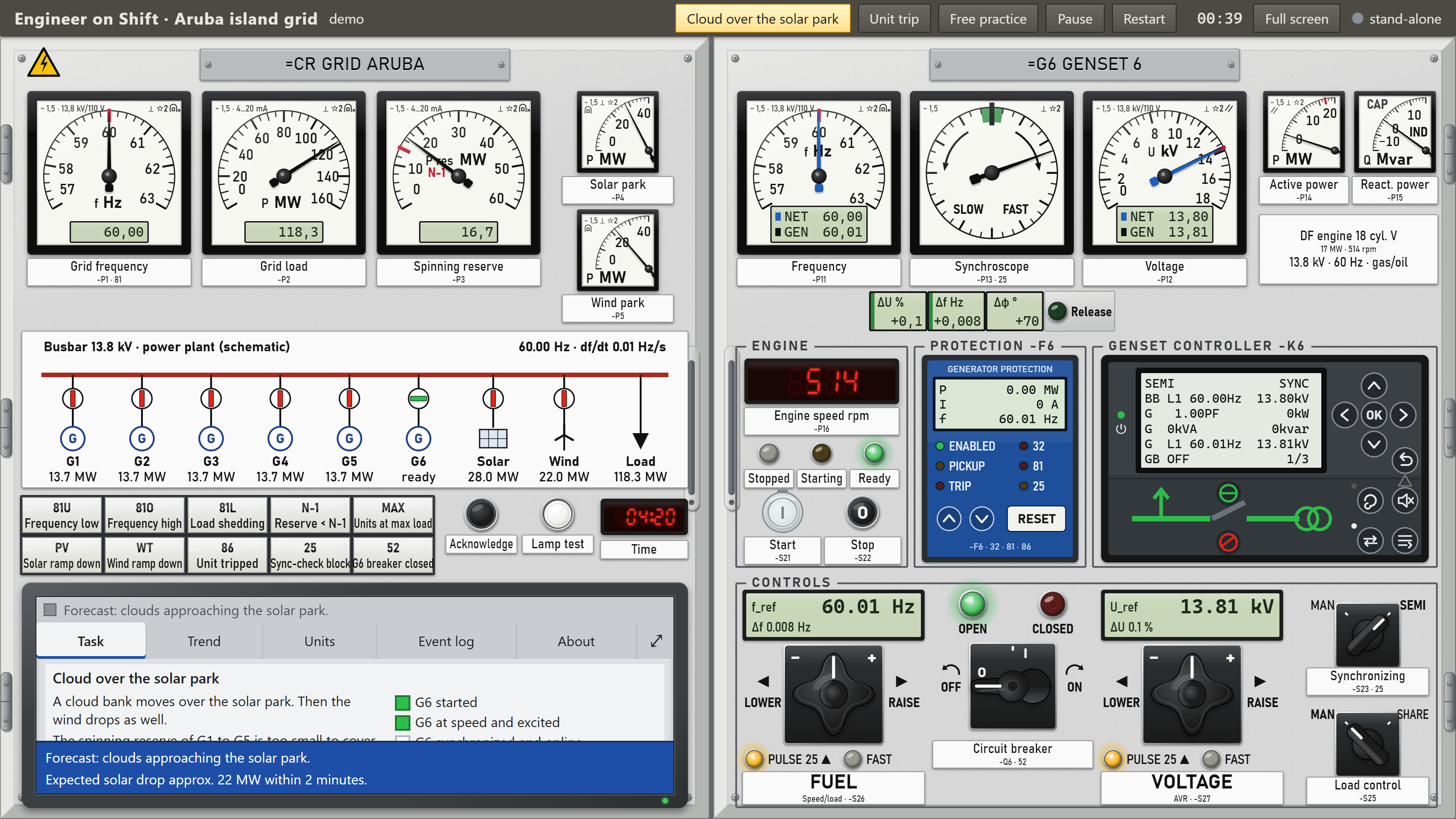
Runs in your browser, best on a laptop or larger screen. Values are indicative.
Built around your operators
Every project starts in your own control room.
- 1
Needs assessment
Interviews and observation: what goes well, and what goes wrong?
- 2
Configure
Your units, settings and scenarios, with lessons and tests.
- 3
Pilot
One module for 15 to 20 operators over three months, with a test before and after.
- 4
Roll out
Only after a good pilot, at your own pace.
Choose the building blocks
- Grid & plant modelYour units, solar, wind, spinning reserve and load shedding
- ScenariosTaken directly from the needs assessment
- Training programmeLessons, pre/post assessment and a record per operator
- Look and feelMeters, controller and relay drawn after your panels
- LanguagesIn your working language
- Black startDead-bus energization and step-by-step grid restoration
- Fuel changeoverDual-fuel switching under load and alarm handling
Start with a needs assessment and a 3-month digital pilot.
Digital, or a real cabinet
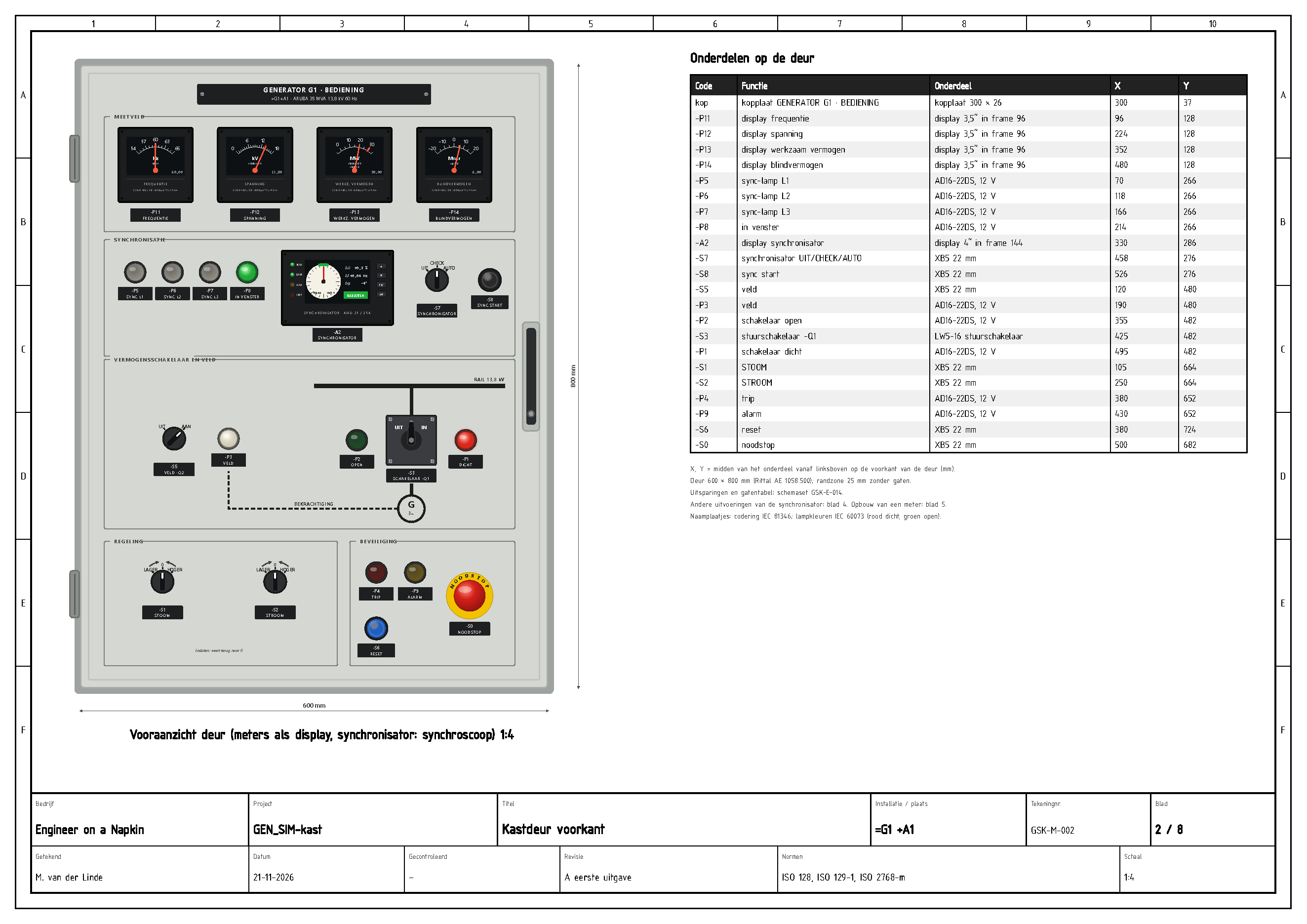
The simulator runs in a browser. If you want real switches and meters, I design and document the cabinet and a local panel builder builds it.
The same approach for water
Reverse osmosis plants have their own rare moments, such as a high-pressure pump trip. They get their own modules.
Michel van der Linde
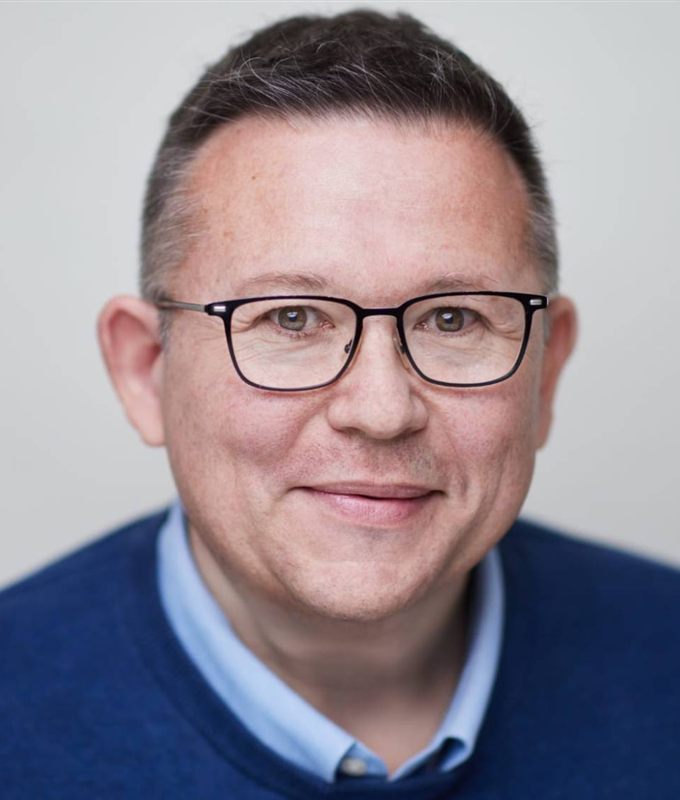
I started in power production on Aruba and later worked across the Dutch energy chain. Today I teach electrical engineering and design training programmes.
Engineer on Shift is part of Engineer On.
Start small: one pilot, one scenario, three months.
Then you decide whether to continue. Hardware is always a separate decision.
michel@engineeronanapkin.com+31 (0)6 1849 0042
- Engineer on Shift brochurePDF, 1.2 MB